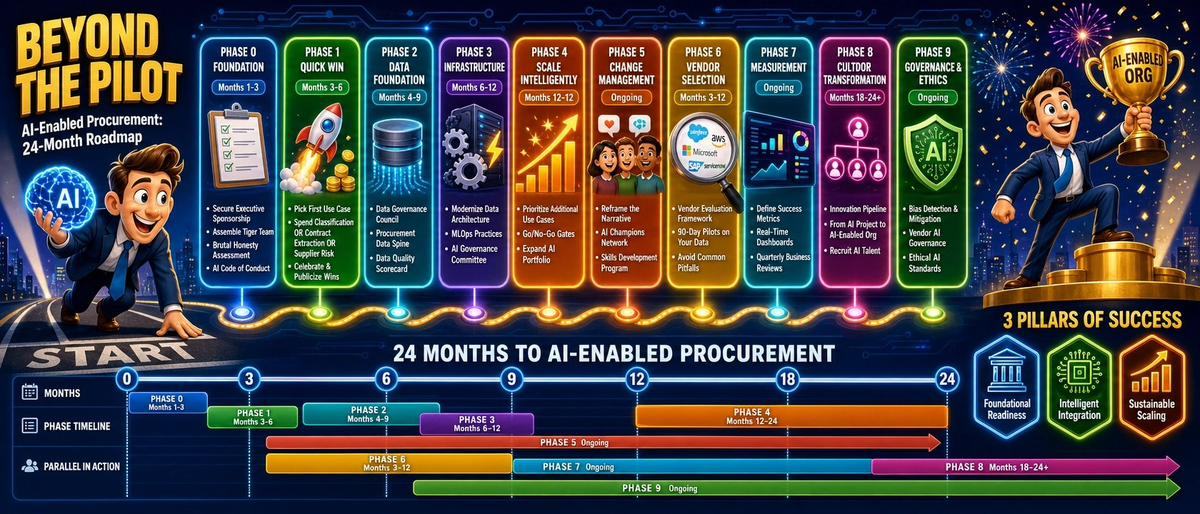
Artificial Intelligence has quickly become one of the most talked-about developments in procurement — and also one of the most misunderstood. Organizations often launch a bold pilot, generate some early excitement, then stall when it's time to scale. The real challenge isn't the technology — it's strategy, people, process, and governance working together. Organizations that get this right realize $2–8M in cost savings and 15–25% process efficiency gains within 18–24 months.
The 10 Implementation Phases at a Glance
| # | Phase | Why It Matters |
|---|---|---|
| 0 | FoundationMonths 1–3 | Without executive sponsorship and an honest readiness assessment, every subsequent phase will be underfunded and under-supported |
| 1 | Quick WinMonths 3–6 | One visible, measurable success breaks organizational skepticism and unlocks budget for the full roadmap |
| 2 | Data FoundationMonths 4–9 | AI models built on dirty data produce unreliable outputs; clean data is a prerequisite, not an afterthought |
| 3 | Infrastructure & GovernanceMonths 6–12 | Modern data architecture and formal AI governance enable safe, scalable deployment across multiple use cases |
| 4 | Scale IntelligentlyMonths 12–24 | Prioritized use case expansion with go/no-go gates prevents overextension and keeps ROI visible |
| 5 | Change ManagementOngoing | Technology without adoption is worthless; sustained change management is the single biggest differentiator between programs that succeed and those that fail |
| 6 | Vendor SelectionMonths 3–12 | The wrong vendor partner — chosen without piloting on your data — is the most common cause of wasted AI investment |
| 7 | Measurement & OptimizationOngoing | Without real-time dashboards and quarterly business reviews, model drift and adoption gaps go undetected until they become crises |
| 8 | Culture TransformationMonths 18–24+ | Sustainable value requires AI embedded in KPIs, budgets, structures, and mindsets — not just project plans |
| 9 | Governance & EthicsOngoing | Bias detection, vendor contractual requirements, and ethical guardrails protect supplier relationships and organizational credibility |
The Three-Pillar Success Framework
Success requires simultaneous, phased investment across three dimensions. Organizations that try to jump straight to scaling without foundational readiness — or who neglect change management while focused on technology — fail predictably.
- Secure executive sponsorship and alignment
- Assess and remediate data quality and skills gaps
- Define a clear, narrow AI vision
- Execute high-impact pilots that demonstrate ROI
- Build modern data foundation and tech ecosystem
- Establish governance and ethical frameworks
- Roll out additional use cases systematically
- Embed AI into permanent org structures
- Transform culture to "AI-enabled organization"
Foundation
This phase is non-negotiable. AI implementation without sustained C-suite commitment fails 80% of the time. The most common mistake is starting with the technology question — "which AI tool should we buy?" — instead of the strategy question — "are we organizationally ready to make this work?"
The four foundational actions of Phase 0 are: securing executive sponsorship at CFO or COO level (not just CPO), assembling a cross-functional tiger team freed from 50% of their regular duties, conducting a brutal-honesty assessment of data quality and team capability, and drafting an AI Code of Conduct before any tool is deployed.
Data Audit benchmark: If more than 15% of transactions have quality issues when you randomly sample 100, you must remediate data before building ML models. Skills benchmark: If fewer than 30% of the procurement team can explain what a machine learning model is, foundational AI literacy training comes before tool implementation.
- Identify a CFO or COO level champion and secure a written charter with multi-year budget and documented decision rights — verbal commitment is not enough
- Assemble the tiger team: Procurement Lead, Data Engineer, Change Champion, Business Analyst, and a part-time Data Scientist. Meet 3× weekly.
- Run the data audit: pull 6 months of spend data, randomly sample 100 transactions, benchmark quality issues honestly against the 15% threshold
- Draft and approve an AI Code of Conduct covering transparency, human-in-the-loop requirements, data governance, and bias detection — before any vendor conversations
- Executive charter signed with named sponsor and approved multi-year budget
- Tiger team assembled with >80% time commitment documented
- Assessment report completed with red/yellow/green status on data, skills, systems, processes
- AI Code of Conduct approved and published
Quick Win
Pick one. Do not run multiple pilots. This is the most critical discipline of the entire roadmap. The purpose of Phase 1 is not to solve procurement with AI — it is to prove that AI works in your organization, build confidence, and earn the right to scale.
Three proven starting points, ranked by suitability for most organizations:
Option A — Tail Spend Categorization (Recommended): Tail spend (purchases under $5,000) represents 80% of transactions but is 25–40% miscategorized. Fixing it unlocks $2–5M in category consolidation. Low technical risk, readily available training data, fast time-to-value.
Option B — Contract Clause Extraction: Identifying avoidable auto-renewals and price escalation terms trapped in PDFs. Early identification of auto-renewals alone can unlock $3–8M in avoided costs.
Option C — Supplier Risk Monitoring: Aggregating risk signals across internal systems and external sources for top 200 suppliers. Highest C-suite visibility; strongest foundation for Phase 2.
- Select one use case and commit fully — resist the pressure to do more
- Invest time upfront ensuring category managers are classifying training data consistently — garbage training data produces garbage models
- Maintain human review of every AI decision for the first 3 months — never trust AI 100% immediately
- Track accuracy %, time saved per transaction, user adoption rate, and business impact in dollars from day one
- Announce results in an all-hands, document a case study, and celebrate the team publicly — momentum is your most valuable asset at this stage
Data Foundation
Phase 2 starts while Phase 1 is still running. While the pilot generates early wins, the data foundation work proceeds in parallel. This is intentional — organizations that wait until Phase 1 is complete before starting data work are 6–9 months behind before they know it.
The goal is a single Procurement Data "Spine" — a unified view linking suppliers, contracts, POs, invoices, and risk attributes. Without it, every new AI use case requires its own bespoke data extraction, slowing deployment and reducing accuracy.
- Establish a Data Governance Council with Procurement Lead, CDO, ERP/P2P/CLM systems owners, Finance, and Legal — meeting monthly
- Map all procurement data sources: ERP, P2P, CLM, external (Dun & Bradstreet, ESG ratings, news feeds)
- Define master data domains: Supplier (with legal entity ID, diversity status), Contract (with renewal trigger dates), Item, and Cost Center
- Run a 6-month data cleansing sprint targeting: >95% of records complete, >95% of spend classified, <2% supplier master duplicates
- Build a monthly Data Quality Scorecard and tie procurement manager performance reviews to it
Infrastructure & Governance Build
Phase 3 establishes the technical architecture and governance structures that allow multiple AI use cases to operate safely and reliably. Without this foundation, each new use case becomes a one-off project with its own data pipelines, its own governance gaps, and its own failure modes.
The technical stack centers on a cloud data warehouse or lake (Snowflake, BigQuery, Databricks), an iPaaS integration layer (Boomi, MuleSoft), ML operations tooling (MLflow, Kubeflow, or vendor platforms), and BI/visualization tools (Tableau, Power BI). Architecture principles: API-first, scalable, secure, and modular.
- Establish a Model Registry — centralized catalog of all ML models in production with version, training data, accuracy, and last retraining date
- Implement automated alerts when model accuracy drifts >5% from baseline — model drift is silent and expensive
- Form an AI Governance Committee (Procurement Lead as chair, Data/ML Lead, Compliance, CPO, Ethics/Diversity rep, external advisor) — meets monthly in Months 6–12, quarterly thereafter
- Require AI Governance Committee approval before deploying any new model or major update
- Establish vendor governance: review and approve all new AI vendors on technical capability, explainability, data security, and contract terms
Scale Intelligently
Phase 4 is where organizations that built the foundation properly begin to see compounding returns. Use cases that would have taken 12 months to implement in Phase 1 now take 3–4 months, because the data is clean, governance is in place, and the team knows how to work with AI.
Score each candidate use case 1–5 on: Business Impact, Data Readiness, User Readiness, and Time-to-Value. Start with the highest-scoring use case, complete it, then move to the next. The impulse to run five use cases simultaneously is the single most common cause of Phase 4 failure.
- Apply the scoring matrix before committing resources to any new use case
- Enforce formal Go/No-Go gates: <5% missing data, >85% model accuracy, >70% of users trained, quantified ROI, Governance Committee approval
- Sequence use cases with clear resource allocation — offset timelines, never overlap starts within the same team
Change Management
Change management is not a phase. It is a continuous practice from Month 1 through Year 2 and beyond. The organizations that treat it as a one-time communication effort — an all-hands announcement and some training sessions — consistently underperform those that treat it as an ongoing capability.
The narrative matters enormously. "AI eliminates tedious work so you can focus on strategy" lands differently than "we're implementing AI tools." Frame every communication around what AI does for the procurement professional, not what AI does to them.
- Select 8–10 AI Champions — influential mid-level practitioners, not the most senior people — and give them early access, monthly deep-dive training, and public recognition
- Roll out a 3-tier training program: Tier 1 (2-hour AI literacy for all staff, Months 4–6), Tier 2 (8–10 hour advanced training for power users, Months 8–12), Tier 3 (technical platform training for data/engineering roles)
- Target: 80% Tier 1 completion within 6 months; self-assessed AI confidence from <30% to >70% at Month 12
- Create new career pathways: Procurement Data Analyst, Procurement AI Lead, AI-Enabled Category Manager
- Tie performance reviews to adoption and data quality KPIs — behavior follows incentives
Vendor Selection & Management
Vendor selection runs in parallel from the early phases. Never buy a large license without first running a 90-day pilot on your specific data. Vendor demonstrations use curated, clean datasets that rarely reflect the reality of your ERP exports. Your data is messier, more contextual, and more specific than any demo dataset.
Evaluate vendors on four dimensions: Technical Capability (35%) — model accuracy, scalability, explainability, API integration; Procurement Domain Expertise (25%) — do they understand sourcing, contracting, supplier management at your scale?; Commercial Terms (25%) — pricing model, SLAs, data ownership, exit clauses; Vendor Viability (15%) — funding, roadmap alignment, support quality.
- Run 90-day pilots on your own data before signing any significant license — this is non-negotiable
- Score vendors against the four-dimension framework before shortlisting
- Call customer references yourself — listen for what they don't say as much as what they do
- Insert contractual requirements: transparency on model training data, audit rights, data ownership, performance SLAs (>85% accuracy guaranteed), and a clean exit clause with 6-month data access
- Establish quarterly business reviews with the vendor's executive sponsor and track SLA compliance monthly
Measurement & Optimization
AI is not a set-it-and-forget-it investment. Models drift as data patterns change. User adoption fluctuates. Vendors change their underlying models. Without a structured measurement cadence, the value realized in Year 1 quietly erodes in Year 2.
- Build two dashboard views: executive (model accuracy trend, adoption %, dollars realized, data quality scorecard) and procurement team (my decisions, my productivity, peer benchmarks)
- Define success metrics per use case before deployment: baseline, 12-month target, measurement methodology
- Conduct quarterly business reviews with the executive steering committee: performance vs. plan, actual dollars realized, issues and risks, and phase transition approvals
- Conduct separate quarterly reviews with the AI Governance Committee: bias testing results, user feedback, vendor compliance, ethical concerns
Culture Transformation
Culture transformation is the final frontier — and the most durable competitive advantage. Technology can be copied; culture cannot. Organizations that reach this phase have AI embedded in their KPIs, budgets, hiring criteria, and daily decision-making language.
The indicators of success are specific: when a new procurement problem arises, the first question the team asks is "how can AI help?" — not "is this an AI problem?". Innovation proposals come from practitioners, not just the AI team. Budget for AI capabilities exists as a dedicated line, not as competition with traditional procurement initiatives.
- Launch a quarterly innovation pipeline: any team member can submit a new AI use case, fast-track evaluation within 2 weeks, 8-week pilot funding for selected ideas
- Target 2–3 new pilots per quarter by Month 18; 30–40% of the procurement team actively participating in submissions
- Build hybrid roles that bridge procurement domain expertise and data science — these are the most valuable and hardest-to-find people in the field
- Pay AI roles 20–30% above standard procurement analyst rates and invest in career visibility (conference sponsorships, company newsletter, LinkedIn)
Governance & Ethics
Governance and ethics are not a compliance checkbox. They are the foundation of trust — trust from suppliers, from procurement practitioners, from leadership, and increasingly from regulators. As supply chain due diligence regulations expand globally (EU CSDDD, US supply chain transparency laws), proactive supplier monitoring and explainable AI decision-making reduce compliance risk and the cost of regulatory penalties.
- Run quarterly bias testing on all AI models across: supplier size, ownership demographics, geography, and industry. Correct bias immediately when detected — don't wait for complaints.
- If the tail spend model assigns "IT Services" at 15%+ higher rate to small suppliers — investigate training data, add supplier size as an explicit feature, re-validate until bias drops to <5%
- Insert contractual AI governance requirements for all vendors: transparency (quarterly model documentation), audit rights, data ownership (your data is yours), performance SLAs, bias testing obligations, and a clean exit clause
- Publish quarterly bias testing results to the AI Governance Committee and document corrective actions taken
Why Organizations Fail — 5 Critical Success Factors
Implementation Budget & ROI
| Budget Category | % of Total | What It Covers |
|---|---|---|
| Vendor Licensing & Tools | 35–40% | AI platform subscriptions, specialized procurement tools, cloud ML services |
| Implementation & Integration | 25–30% | System integration, ERP/P2P/CLM connectivity, configuration |
| Internal Labor | 20–25% | Tiger team time, release from regular duties, training delivery |
| Infrastructure & Data | 10–15% | Data warehouse, integration platform, 6-month data cleansing sprint |
Expected returns: Year 1: $2–5M (tail spend consolidation, avoided auto-renewals, cycle time savings). Year 2: $5–10M (expanded use cases, demand optimization). Year 3+: $10–15M+ (compounding value). Payback period: 12–18 months. Ongoing operational cost: $400–600K/year.
Eight Critical Implementation Principles
The Future of AI in Procurement
Procurement organizations that implement this ten-phase roadmap with discipline will achieve measurable, lasting transformation — not just a successful pilot. The gap between organizations that treat AI as a strategic transformation and those that treat it as an IT project is already widening. Within five years, it will be a competitive chasm.
- 30–50% reduction in procurement cycle times
- 15–25% reduction in transaction costs
- $5–10M in quantified cost savings
- 40–60% reduction in low-value transactional work
- 30–40% increase in strategic sourcing capacity
- Proactive supplier risk management vs. reactive
- Improved decision quality across sourcing and contracting
- Digital capability that attracts and retains talent
- Shift from "doing AI" to "AI is how we work"
- Team engaged in continuous innovation pipeline
- Procurement recognized as transformation leader
- Sustainable AI talent pipeline built internally
The barriers are real: data chaos, organizational inertia, limited skills, governance gaps. But every barrier in this article has a documented solution. Pick your Phase 0 activities this week. Secure executive sponsorship this month. Begin Phase 1 in 90 days. Your competitors are already moving.
References
- Procure.ai. How to build an AI roadmap for procurement. procure.ai
- McKinsey & Company. Transforming procurement functions for an AI-driven world. mckinsey.com
- Beroé Inc. Practical roadmap for intelligent procurement decision-making. beroeinc.com
- Zip HQ. The executive guide to agentic AI in procurement. ziphq.com
- Ivalua. Procurement transformation: AI in the sourcing function. ivalua.com
- LevelPath. AI governance for procurement. levelpath.com
- High Peak Software. Why an AI adoption strategy is critical for CPO success. highpeaksw.com
- Art of Procurement. My AI governance framework for procurement. artofprocurement.com
- World Economic Forum. Adopting AI Responsibly: Guidelines for Procurement of AI Solutions (2023). weforum.org