Blockchain in Public Sector Procurement: A Clear, Practical Guide
Stripping away the hype to explain blockchain honestly — specifically as it applies to public sector procurement evidence, auditability, and defensibility.
Blockchain is often surrounded by hype, misinformation, and unnecessary complexity. This guide strips away the marketing and explains blockchain in honest, practical terms — specifically as it applies to public sector procurement.
At its core, blockchain solves a specific problem: how to maintain a shared, tamper-resistant record of procurement events that multiple parties can rely on without needing a central authority to certify the truth. For public sector procurement teams, it is valuable as a record-keeping and evidence infrastructure layered on top of existing ERP, e-procurement, and financial systems — not as a replacement technology.
This guide is written for federal, provincial, municipal, and Crown corporation procurement, finance, audit, and policy teams who need to evaluate whether blockchain makes sense for their specific procurement challenges.
Part 1: The Fundamentals
Think of blockchain as a shared notebook. Every page records events. Once a page is written, no one can erase or change it. Everyone has their own identical copy. New pages are only added if most people agree the information is accurate.
The core components are straightforward. A block is one page in the notebook, containing a list of events and a cryptographic fingerprint — called a hash — of the previous page. A chain links those pages together so that changing any old entry causes everything after it to break instantly. A distributed ledger means everyone holds the notebook, with no central copy that someone controls.
Keeping permanent records that cannot be secretly altered. Preventing quiet tampering — changes are visible to everyone. Making transactions transparent across multiple parties. Tracking ownership and responsibility over time.
Speed — it is slower than normal databases. Simplicity — it is conceptually heavier to operate. Fixing bad data — there is no delete button. It is a tool. Powerful in the right job. Counterproductive in the wrong one.
Part 2: Building Blocks for Procurement Use
Smart Contracts: A Misleading Term
A smart contract is not smart and it is not a contract. It is simply a small program stored on the blockchain that runs automatically when conditions are met. Think vending machine, not lawyer. You put in $2, press B7, the machine releases chips. No cashier. No negotiation. No mercy.
In public sector context, a smart contract functions as an automated control rather than a contractual instrument. It enforces rules that already exist — such as approval thresholds or payment conditions — without discretion or interpretation. Smart contracts do not decide what should happen. They ensure that what was already decided happens consistently and on time. Legal obligations remain governed by legislation, policy, and written agreements.
Public vs Private Blockchains
| Type | Think of it as | Good for | Tradeoffs |
|---|---|---|---|
| Public | Open town square | Cryptocurrencies, public transparency | Slower, more expensive, less privacy |
| Private | Gated community | Government records, procurement, enterprise | Less decentralized, requires governance |
Most real-world government use cases end up private or hybrid, not fully public. Ideology bows to practicality.
Part 3: Blockchain in Procurement
Public procurement typically involves contracting authorities, suppliers, central agencies, finance teams, auditors, and oversight bodies — each often interacting through separate systems. Most procurement disputes do not arise from misconduct. They arise from misaligned records, unclear timelines, and inconsistent versions of events. The most common problem statement is: "That is not the version we have on file."
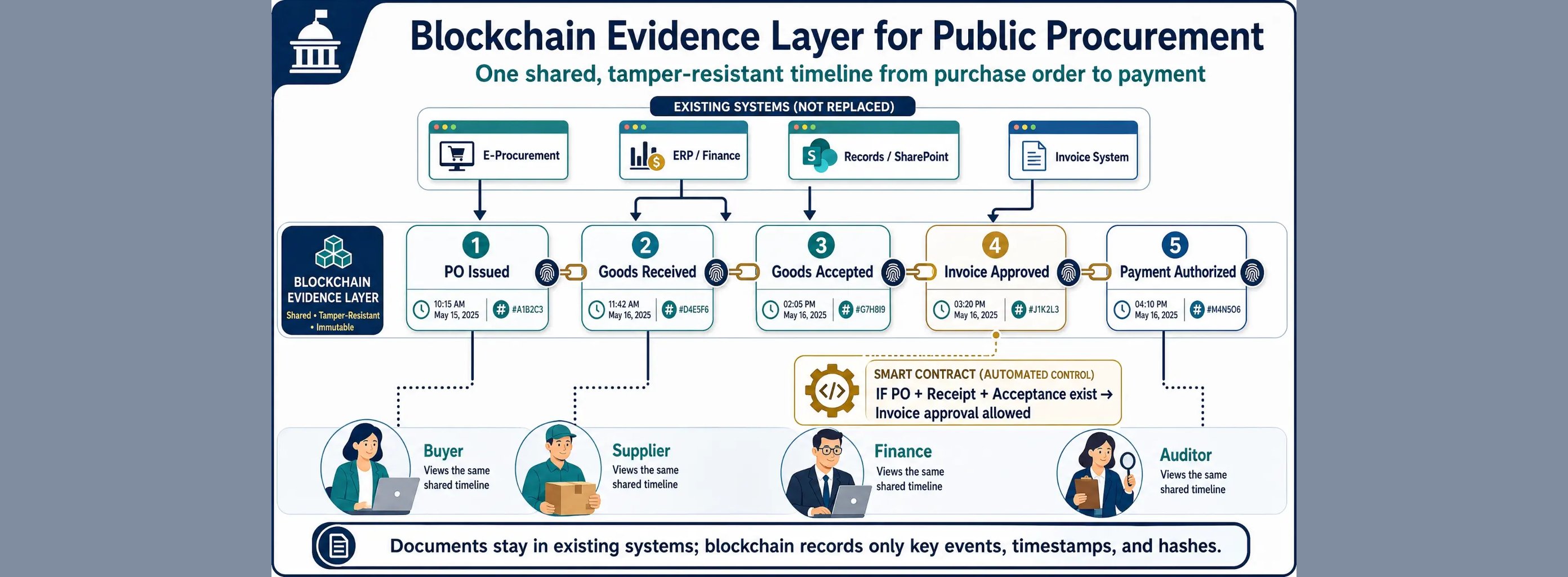
Blockchain is designed for exactly this environment: many stakeholders, limited mutual trust, and a high requirement for defensible records. Imagine one shared storybook sitting in the middle. Buyer sees it. Supplier sees it. Finance sees it. Auditor sees it. Same book. Same pages. Same history. No one can edit old pages, lose approvals, or quietly backdate changes.
Blockchain doesn't replace procurement logic. It replaces procurement arguments.
Real-World Example: Paying a Supplier
A provincial ministry procures IT equipment under a standing offer. The blockchain evidence layer records five key events — not the documents themselves, but tamper-proof entries confirming that each event occurred.
Purchase Order Issued
Contract identifier, supplier ID, PO number, date and time written to the blockchain. The document stays in the procurement system. The record of issuance is immutable.
Goods Received
Confirmed through existing systems. A second blockchain entry records quantity, reference identifiers, and time of confirmation — a shared, timestamped acknowledgement of delivery.
Goods Accepted
If inspection is required, acceptance is recorded as a separate entry. Clear sequence: PO issued → received → accepted. Each step linked, none overwriting the previous.
Invoice Approved
The invoicing system checks the blockchain to confirm the PO exists, delivery has been recorded, and acceptance has occurred. If conditions are met, the invoice proceeds. If not, it is flagged automatically.
Payment Authorized
A final entry records payment authorization, date and time, and reference to the invoice. A complete, immutable timeline from award to payment — provable months or years later without reconstructing emails.
Part 4: Blockchain vs Enterprise Systems
Blockchain is often compared to SharePoint. They serve different and complementary purposes. SharePoint supports managed versioning — historical versions exist, but administrators may delete them and retention schedules may purge history. The system owner ultimately controls the record.
Blockchain uses a fundamentally different approach. Records are never overwritten. New entries are appended. Each references the prior record. The full sequence of events is preserved and cannot be altered or removed without detection.
Rather than asking "What is the latest version?" blockchain answers: "What exactly happened, in what order, and when?"
Blockchain does not replace SharePoint. It replaces disputes about historical records. When a single trusted authority governs the system, SharePoint is sufficient. When multiple parties must rely on the same record without mutual trust, blockchain provides additional assurance.
Part 5: Implementation
The goal is not to build a new blockchain system. The goal is to add a blockchain-based evidence and control layer around existing procurement workflows — specifically around key decision points where timing, sequence, and defensibility matter.
When NOT to Use Blockchain
Blockchain is the wrong tool when: you need speed above all else; one trusted authority already controls everything; data must be easily changed or corrected; or procurement rules change constantly. Blockchain is discipline in software form. If your process is chaos, it will preserve chaos forever.
Building It: Step by Step
The implementation logic is straightforward once framed correctly. You are not building a blockchain system — you are creating a trusted, timestamped record of key procurement events that multiple parties can rely on without arguing later.
Decide what to record
Choose a small number of high-value decision points — typically 5 to 7. For a supplier payment use case: PO issued, goods received, goods accepted, invoice approved, payment authorized. Record too much and the system becomes unusable. Too little and it adds no value.
Define what recording means
Recording does not mean uploading files. Each event creates a transaction record containing: event type, reference ID, who recorded it, date and time, and a cryptographic reference to the underlying document. Documents stay where they are — in ERP, procurement platform, SharePoint, finance system.
Define smart contract rules
Document business rules in plain language first. If you cannot write the rule clearly, do not automate it. Example: "Invoice approval requires PO + receipt + acceptance." Then translate to IF-THEN logic.
Define integration and permissions
Most users read blockchain records. Only systems write blockchain entries. This limits risk while providing broad visibility.
Part 6: Policy and Control Framework Alignment
Blockchain directly supports core public sector accountability principles. For procurement teams, it strengthens three areas:
Fairness and Transparency — Blockchain creates verifiable evidence that all bidders were treated equally and that approvals followed policy. Useful for protested procurements and audit defense.
Auditability — Strengthens audit evidence for bid process integrity, payment controls, and approval authority compliance.
Accountability — Provides clear records of who approved what and when, without altering existing authorities or decision rights.
Within a COSO framework, blockchain functions as both a preventive and detective control. As a preventive control, it enforces procurement sequence — PO before receipt, receipt before invoice approval, approval before payment. As a detective control, it preserves immutable records making unauthorized actions or timeline manipulation visible immediately.
Blockchain does not make procurement faster. It makes procurement defensible. And defensibility is political oxygen in public sector environments.
Part 7: Procurement Reality Check
Where blockchain fails in procurement pilots
- Ambiguous business rules — if you cannot write the procurement rule clearly, you cannot automate it
- Constantly changing procurement policy — blockchain enforces rules perfectly and permanently
- Lack of executive or procurement leadership commitment
- Trying to solve too many procurement problems at once
- Treating blockchain as an innovation exercise instead of a control mechanism
- Weak engagement with audit and records management from the start
Where blockchain succeeds
- Narrowly scoped to one procurement problem — payment confirmation, bid timestamping, or approval tracking
- Governance-led by Procurement or Finance, not IT innovation teams
- Clear business case: evidence, defensibility, reduced disputes — not cost or speed
- Complementary to existing systems — layered on top of ERP and e-procurement platforms
- Strong audit and records management partnership from Phase 1
- Realistic risk assessment acknowledging operational dependency and rule rigidity
Conclusion: Blockchain as Procurement Evidence Infrastructure
Blockchain in public sector procurement is not about cryptocurrency or technological novelty. It is about solving a specific procurement problem: how to maintain defensible, tamper-resistant records of key events when multiple parties do not fully trust each other's systems.
It replaces "Trust us, we followed the rules — and here are our emails to prove it" with "Here is the immutable ledger. The evidence is built in."
For federal departments, provincial ministries, municipal governments, and Crown corporations, this shift is not revolutionary. It is pragmatic, auditable, and aligned with public accountability.
Blockchain in procurement succeeds only when it is narrowly scoped, rigorously governed, integrated without replacing existing systems, treated as a control and evidence layer — and led by procurement and finance, not IT teams chasing new technology.